Uzbekistan's first ID card fee faces scrutiny as peers go cheaper
Uzbekistan's BHM-linked fee model is under pressure as regional benchmarks show cheaper, waived or fully subsidized first-time identity issuance.
A debate over the price of a first ID card in Uzbekistan has moved from social-media outrage into a broader discussion about how the state prices a basic public service. The trigger was a post by journalist Dilnoza Qurbonova describing a father and his 15- or 16-year-old daughter at a passport office for the girl's first identity card. When staff announced the fee due at the cashier, the father's hands began to shake as he opened his wallet and counted the money inside.
He opened his wallet and began counting even the last small coins one by one. Seeing the father's anguish and his daughter's eyes drop first to him and then to the ground, my heart ached.
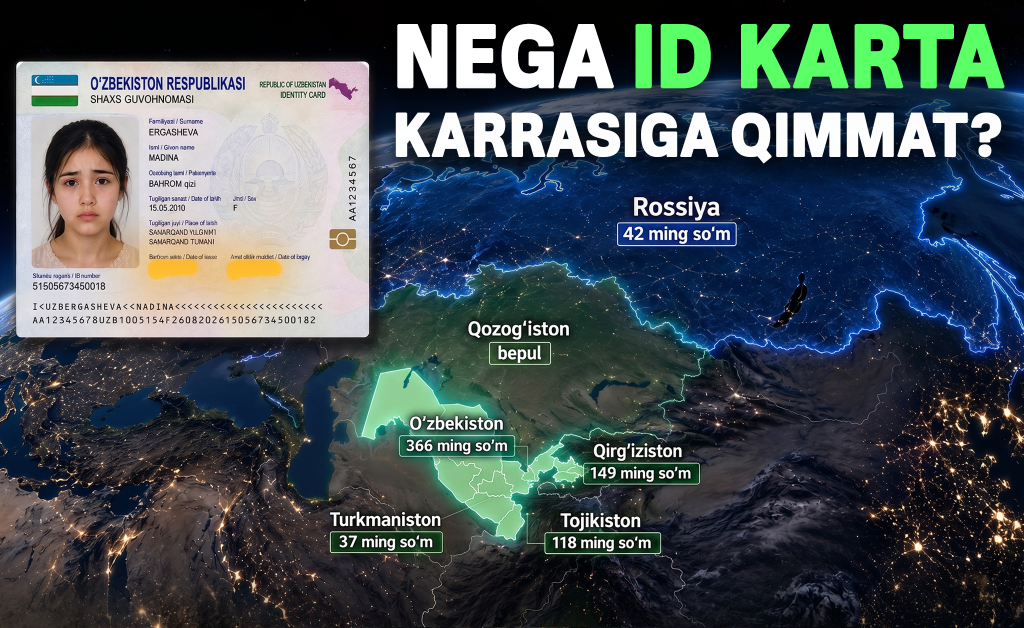
The episode has pushed a simple policy question onto the agenda: how expensive should the first proof of legal identity be for a citizen entering adulthood? In Uzbekistan, the answer depends on the application channel. A first ID card obtained through a migration department, a Public Services Center or a consulate carries a state duty equal to 89% of the base calculation amount, or BHM. Because the BHM is currently 412,000 soum, the fee now stands at 366,680 soum. If the application is submitted online through 'my.gov.uz', the charge is set at 80.1% of the BHM, or 330,012 soum.
The structure matters because it ties a core identity service to a floating benchmark rather than a fixed nominal price. Since August 1, 2025, the BHM has been set at 412,000 soum. From September 1, 2026, it will rise to 440,000 soum. If the fee ratios remain unchanged, the state duty for a first ID card will increase to 391,600 soum through migration offices, Public Services Centers or consulates, and to 352,440 soum through 'my.gov.uz'. In practice, that makes the first-ID tariff partly index-linked and leaves citizens exposed to automatic increases.
From a management perspective, the Uzbek model balances two objectives that do not always fit neatly together: preserving fee revenue and steering users toward lower-cost digital channels. Indexing the duty to the BHM protects the real value of the charge when the benchmark rises. The lower online rate also creates a built-in incentive to use digital processing instead of physical counters. But the public reaction shows that the economic logic of pricing and the social logic of universal access are now colliding around the first document a young citizen must obtain.
Regional benchmark exposes a strategic gap
Across the eight-country comparison, the regional benchmark is uncomfortable for Tashkent because several neighboring or comparable systems are materially cheaper, and in some cases free, at the point of first issuance. Kazakhstan has moved furthest toward subsidy. From January 1, 2026, every citizen who turns 16 can receive an ID card for the first time free of charge and can renew it free when it expires. The fee is also waived for people obtaining the document for the first time after age 18, for those taking Kazakh citizenship, and in some other cases. The initiative is aimed at reducing citizens' financial burden and simplifying document issuance.
Kyrgyzstan still charges for a first ID card, but at a much lower level. Citizens can obtain the document in the standard process within 12 working days for 1,103 Kyrgyz som, which at the current exchange rate is about $12.6 or 149,000 Uzbek soum. That makes the ordinary first-ID process in Kyrgyzstan about 2.5 times cheaper than Uzbekistan's current 366,680-soum duty. Tajikistan charges $10 for an ID card, collected in somoni at the exchange rate on the day of payment, with processing set at up to 15 days. At the Central Bank of Uzbekistan's official rate on August 21, that is roughly 118,000 soum, or about 3.1 times cheaper than the Uzbek charge.
Turkmenistan uses a different document model: there is no separate national ID card, and the main identity document is a biometric passport. According to the State Migration Service, the state duty for that passport is 60 manat. At the black-market exchange rate, that is approximately $3.2 or 37,000 Uzbek soum. Children under 16 are exempt from the fee, making the charge roughly 10 times lower than Uzbekistan's current first-ID duty. Russia also prices first identity issuance far below Uzbekistan. Citizens receive an internal passport at age 14, and the state duty for first issuance is 300 rubles, or about $3.6 and 42,000 soum at the current exchange rate. That is around 8.7 times cheaper than the Uzbek fee. Under Russia's Tax Code, the same 300-ruble duty applies both when the passport is first issued and when it is replaced under standard procedure, while the fee rises to 1,500 rubles if the passport is lost or becomes unusable.
Turkey's main identity document is the 'Türkiye Cumhuriyeti Kimlik Kartı'. In 2026 its listed price is 220 Turkish lira, or about $5 and 59,000 Uzbek soum. But if a child's birth is registered within the period set by law and a first identity card is issued accordingly, no fee is charged. A late-issued card or a replacement costs 220 lira. Azerbaijan issues identity cards from age 15. According to the Interior Ministry, the state duty for standard 10-day processing is 5 manat.
For policymakers, the comparison leaves a clear strategic question. Uzbekistan's first-ID fee is not just higher in nominal terms; it is structured to rise automatically with the BHM unless the underlying rate is changed. That may be defensible as an administrative pricing mechanism, especially if the state wants predictable fee revenue and stronger uptake of online channels. Yet the regional landscape shows other governments increasingly treating first identity issuance as a low-cost or subsidized gateway service. In that context, the debate is no longer only about one father at one cashier window. It is about whether the first document of citizenship should be priced as a recoverable transaction or managed as an entry-level public entitlement.