Serbia’s Election Puts Vucic’s Political Strategy Under Severe Pressure
A student-led opposition movement is challenging Serbia’s ruling party and Vucic’s plan to retain power by moving into the premiership.
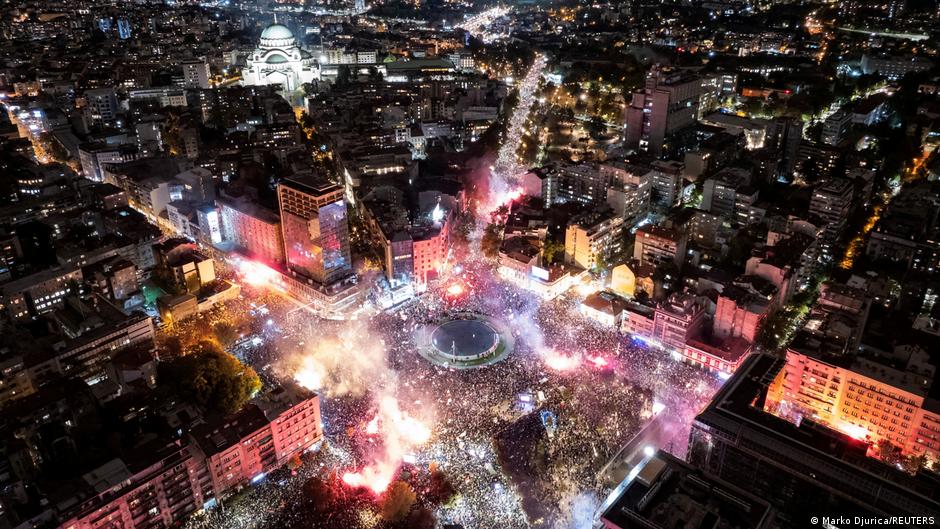
Serbia’s political leadership faces a potentially disruptive change in control after an opposition rally in Belgrade drew around 150,000 people ahead of snap parliamentary elections scheduled for October 25. The turnout figure was provided by organizers of the demonstration held on Thursday, October 22.
The protest underscored the scale of the challenge confronting President Aleksandar Vucic and his Serbian Progressive Party, or SNS. Vucic has occupied Serbia’s presidency since 2014 and, despite statements that he would resign, intends to remain at the center of government by seeking the position of prime minister in the coming vote.
For businesses and investors, the election raises questions about policy continuity, institutional authority and the durability of a governing model closely associated with one dominant political figure. A victory for SNS would effectively preserve Vucic’s control, although through a different office. A victory for the opposition-backed Student List would introduce a less conventional political coalition with no clear leader and no professional politicians among its candidates.
A Leadership Transition Without a Transfer of Power
Vucic’s planned move can be understood as a strategic reallocation of authority rather than a conventional departure. Under Serbia’s Constitution, the prime minister has broader powers than the president. Yet Vucic has remained the most recognizable figure in the governing establishment throughout his presidency, while successive prime ministers have come from his party.
He also has direct experience in the role he is now seeking. Vucic served as prime minister from 2014 until 2017, leaving the post after winning the presidential election. His return would therefore restore him to a constitutionally stronger office while maintaining the political continuity that has defined Serbia’s government for more than a decade.
The October 25 vote is not simply a contest between parties; it is also a test of whether Vucic can preserve control by changing positions within the state.
That strategy, however, is being tested by a movement that operates outside Serbia’s established party structures. Demonstrators in Belgrade called for an end to Vucic’s rule and urged voters to support the Student List, which emerged during a prolonged wave of student protests and has developed into a significant political force.
Protests Become an Electoral Competitor
The snap election follows almost two years of demonstrations triggered by the November 2024 railway-station disaster in Novi Sad. Sixteen people were killed when a canopy collapsed at the station, which had been renovated only shortly beforehand. Serbia’s independent media and opposition identified corruption as one of the main causes of the tragedy.
Students became the principal driving force behind the resulting protests. Their campaign has now evolved into the Student List, creating a direct electoral challenge to SNS. Rather than recruiting established political professionals, the movement wants academics, activists and public figures to represent it.
This structure differentiates the Student List from a traditional political organization, but it also creates management questions. The absence of a clear leader may broaden its appeal and reduce dependence on a single personality. At the same time, it could make decision-making, coalition negotiations and the execution of government policy more complicated if the movement wins.
Most Serbian opposition parties have withdrawn from the race and called on voters to support the students. The decision amounts to a consolidation strategy: instead of fragmenting the anti-government vote among several competing organizations, the established opposition is placing its electoral weight behind one emerging movement.
Polling Signals a Close Competitive Contest
The Student List’s unconventional approach may produce results. A poll by the New Serbian Political Thought project, published on October 20, showed the movement ahead of SNS. It received support from 44.5% of respondents, compared with 42.7% for Vucic’s party.
An equivalent survey in early October also placed the Student List first, with 44.4% support against 41.7% for the governing party. The two polls suggest that the student movement’s support remained broadly stable while backing for SNS increased by one percentage point, narrowing but not eliminating the gap.
The figures point to a highly competitive election rather than a decisive realignment. For Vucic, the central strategic issue is whether his personal prominence can continue to mobilize enough support for SNS despite nearly two years of protests. For the Student List, the challenge is converting protest participation and polling strength into an effective electoral organization.
The outcome will determine more than the formal composition of parliament. An SNS victory would validate Vucic’s attempt to shift from the presidency to the premiership and retain political control. A Student List victory would break the governing party’s hold on the prime minister’s office and test whether a decentralized movement of academics, activists and public figures can develop the management capacity required to govern Serbia.