Trump Threatens EU Trade Curbs as Brussels Courts Canada Partnership
The U.S. president’s warning raises the stakes for EU-Canada alignment as companies confront a more volatile North Atlantic trade order.
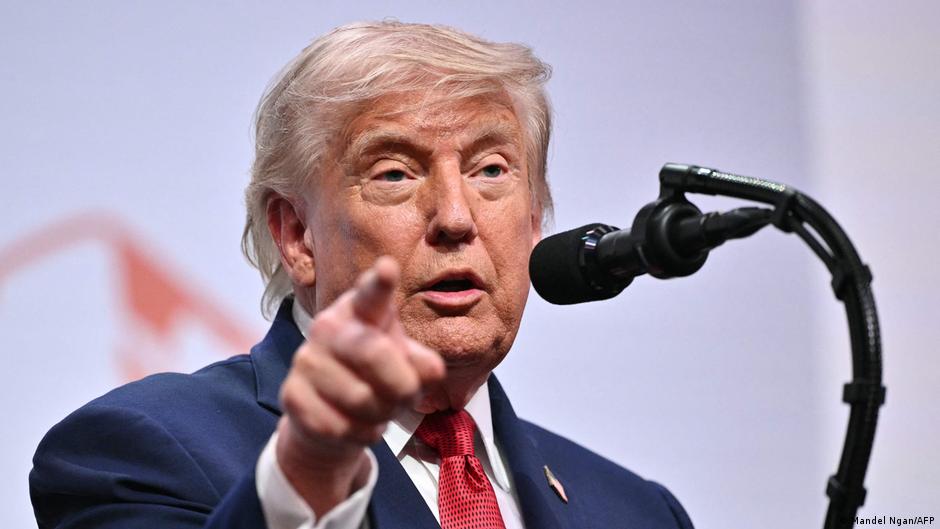
U.S. President Donald Trump has threatened to halt trade with the European Union or impose sharply higher tariffs if Brussels continues to expand its partnership with Canada, injecting fresh uncertainty into corporate planning across three major Western markets.
Speaking on Wednesday, September 16, at a campaign event in North Carolina, Trump responded to European Commission President Ursula von der Leyen’s proposal to make Canada the EU’s first “associate member.” The president described the idea as “ridiculous” and said he would judge whether the move represented a hostile act toward the United States.
“If they do that and I consider it in any way an unfriendly act, I will impose very high tariffs or stop trade with Europe,” Trump said.
He added that the outcome would depend on intent. “If the intentions are good, everything is fine. If the intentions are bad, we will put very high tariffs on Europe, that is one of the possibilities,” he said.
For business leaders, the remarks matter less as a single political outburst than as another signal that U.S. trade policy remains a direct strategic risk. Companies with supply chains spanning North America and Europe now face the possibility that commercial decisions, procurement access and cross-border investment could be disrupted by geopolitical interpretations of alliance-building.
Strategic Alignment Becomes a Trade Risk
Von der Leyen outlined the EU’s ambitions for a deeper Canada relationship on September 16 in the European Parliament, where Canadian Prime Minister Mark Carney was present. She said the EU wanted to take relations with Canada to “the highest possible level” and that she and Carney wanted to work toward making Canada the bloc’s first associate member.
The European Commission chief did not provide details on what such a partnership would include. She did, however, refer to cooperation in technology and the defense industry, two sectors where scale, supply security and trusted partners are increasingly central to corporate strategy. Von der Leyen also emphasized that cooperation between Canada and the EU “will not be directed against others” and would be intended to make both sides stronger.
That language points to the management dilemma now facing governments and multinational companies alike. The EU and Canada appear to be searching for more resilient partnerships at a time when U.S. policy has become less predictable. But the more formal and strategic those partnerships become, the more they may be viewed by Washington as competitive rather than complementary.
According to AFP, Canada, like the EU, is suffering from Trump’s unpredictable trade and foreign policy. That is why both Canada and the European Union are looking at new alliances. For corporate boards, the implication is clear: geopolitical diversification may reduce reliance on one partner while increasing exposure to retaliation from another.
Canada Faces Direct U.S. Procurement and Tariff Pressure
The latest warning to Europe came alongside a separate escalation in U.S.-Canada trade tensions. The White House said Trump signed a memorandum on September 16 that would bar Canadian goods from federal government procurement. According to the press release, Washington is taking the measures in response to Canada’s actions, which it said “unreasonably imposed new barriers” on American companies seeking access to the government procurement market.
The procurement measure adds a management challenge for Canadian exporters that sell into public-sector supply chains or depend on U.S. federal purchasing as part of broader market access. It also sends a message to European companies watching the dispute: procurement rules, tariffs and alliance politics are increasingly intertwined.
Since September 15, the Trump administration has imposed additional 50 percent tariffs on Canadian cheeses, steel, aluminum, paper, furniture, light fixtures and other goods. Administration officials said the step was a direct response to Ottawa’s new tariffs.
Canada’s tariffs on roughly $20 billion worth of U.S. exports also took effect on September 15. Those measures were themselves a response to U.S. tariffs of 50 percent on $20 billion worth of Canadian goods that came into force on August 22. Canada withdrew from trade negotiations with the United States on August 21.
The sequence shows how quickly retaliatory measures can harden into a broader trade conflict. For companies, this is not only a pricing issue. Tariff exposure affects sourcing contracts, customer negotiations, working capital, inventory placement and decisions about where to locate production. The added threat of procurement exclusion raises the stakes for firms that rely on public contracts or sell components into government-facing supply chains.
Competitive Landscape Shifts Across the Atlantic
The proposed EU-Canada arrangement, while still undefined, would likely be watched closely by businesses in technology, defense, manufacturing and industrial inputs. Even without formal details, the political direction suggests that Brussels and Ottawa see value in deeper institutional links beyond traditional trade agreements.
For the EU, closer ties with Canada could support efforts to diversify partners in critical sectors and strengthen cooperation with a stable, resource-rich economy. For Canada, a more formalized relationship with the EU could create an alternative strategic platform as ties with Washington deteriorate. For U.S. companies, however, such a partnership may alter the competitive landscape if it leads to preferential cooperation, procurement alignment or coordinated industrial policy between Canada and Europe.
Trump’s response underscores that the United States may seek to deter such moves through tariffs or trade restrictions. That creates a difficult calculus for European and Canadian policymakers. A cautious approach could limit immediate friction with Washington but slow efforts to build resilience. A more ambitious partnership could give companies clearer strategic alternatives, while risking U.S. retaliation that would raise costs across multiple sectors.
At this stage, the EU has not specified the structure, obligations or commercial benefits of Canadian “associate membership.” That uncertainty matters. Corporate strategy teams cannot yet model the upside of the proposed partnership, but they can see the downside risk of an escalating political reaction from Washington.
The result is a familiar but intensifying pattern: trade policy is becoming less predictable, strategic alliances are being interpreted through a competitive lens, and companies are being forced to plan for policy shocks that can arrive faster than supply chains can adapt.