Trump Says Putin More Motivated Than Zelensky to Reach Ukraine Peace Deal
The U.S. president’s comments on an energy ceasefire dispute place Washington’s leverage and Kyiv’s negotiating posture at the center of the war diplomacy.
U.S. President Donald Trump said Russian President Vladimir Putin is more interested than Ukrainian President Vladimir Zelensky in reaching a peace agreement over Ukraine, a statement that sharpens attention on Washington’s role as mediator and on the competing incentives facing the two wartime governments.
Speaking to reporters overnight on Tuesday, October 13, Trump was asked about Russia’s alleged violation of an energy ceasefire in the war against Ukraine. The U.S. president responded that the matter first needed to be examined, adding that, in his view, “violations were on both sides.” He also said he believed Putin wanted peace and that the greater task was persuading Zelensky to accept a deal.
The remarks add a new layer to an already fragile diplomatic track. For businesses, investors and governments monitoring Ukraine’s wartime economy, the dispute over energy infrastructure is not only a military or humanitarian issue. It is central to the country’s industrial capacity, power stability, reconstruction prospects and the risk calculations of companies with exposure to the region.
Washington’s Mediation Strategy Comes Into Focus
Trump’s comments suggest a negotiating framework in which the White House sees Moscow as potentially ready for a transaction and Kyiv as needing to be brought toward an agreement. Asked by a reporter what evidence he saw of Putin’s readiness to compromise while Russian forces continued to attack Ukraine, Trump replied that he believed the parties would come to terms.
“I think they will make a deal. I really think Putin is more interested than Zelensky in making a deal,” Trump said.
That assessment is politically consequential because it assigns relative negotiating motivation to the two leaders. In corporate strategy terms, the White House appears to be evaluating each side’s willingness to close a transaction, with the proposed peace arrangement functioning as the ultimate deal. The risk is that the two principals define value very differently: Moscow may view territorial, military or strategic concessions as the core terms, while Kyiv is focused on sovereignty, security guarantees and the protection of critical infrastructure.
Trump’s answer also raises questions about enforcement. The energy ceasefire, as described in the source account, was announced by Trump, yet Kyiv says Russia has not implemented the conditions. If a limited ceasefire around energy assets cannot be verified or enforced, broader negotiations would face an even more complex management problem. Any durable arrangement would require monitoring mechanisms, escalation procedures and credible consequences for non-compliance.
Energy Infrastructure Becomes a Test of Credibility
Zelensky previously called on the United States to influence Russia so that it would begin observing the ceasefire regime in the energy sector. Speaking at the Warsaw Security Forum, the Ukrainian president said Kyiv was waiting to see what concrete steps the Americans were prepared to take.
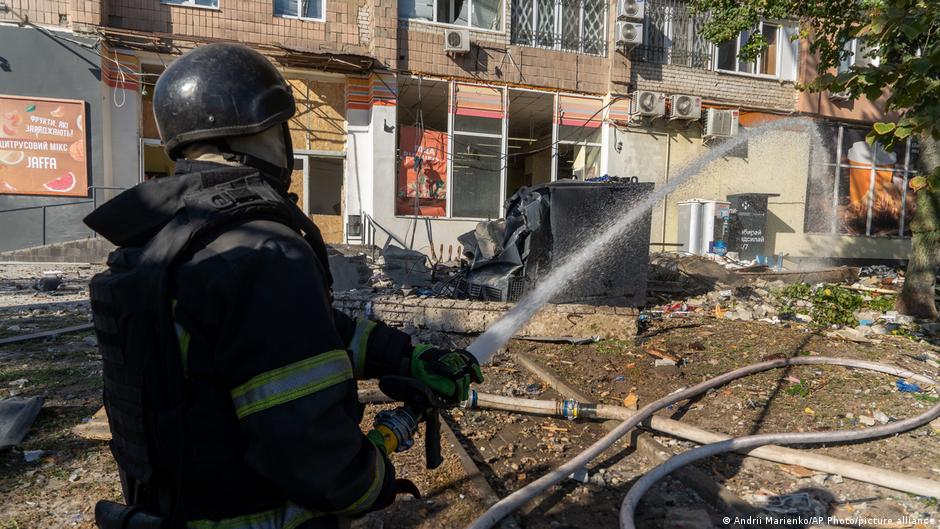
According to Zelensky, Kyiv was highly surprised on October 11 by social media reports that all attacks on energy facilities in Russia’s war against Ukraine would immediately stop. He said that immediately after that statement was published, Russia struck a thermal power plant in Kharkiv, causing additional damage to Ukraine’s energy system.
For Ukraine, attacks on power generation and distribution assets carry direct economic consequences. Energy disruption affects manufacturing, logistics, municipal services, winter preparedness and the operating environment for domestic and foreign companies. For Russia, the pressure campaign against energy infrastructure has been a recurring instrument of war. That makes any energy ceasefire a key indicator of whether Moscow is prepared to limit certain military actions in exchange for diplomatic progress.
Zelensky’s position, as stated in his Telegram message on the evening of October 12, was that Ukraine supported an energy ceasefire and was prepared to guarantee it as announced by the U.S. president. He said Russia needed to take corresponding steps and that, at that point, Ukraine did not record Russian implementation of the conditions voiced by Trump.
“Much depends specifically on the position of the United States for de-escalation to work after all. It is necessary to put pressure on Russia,” Zelensky wrote.
That message places responsibility for leverage squarely on Washington. From Kyiv’s perspective, U.S. influence is not simply diplomatic cover but a practical enforcement tool. Zelensky also said Ukraine continued negotiations with the American side at all levels, signaling that the issue is being managed through multiple channels rather than through public statements alone.
A Deal-Making Lens Meets Wartime Realities
Trump’s framing of the conflict through the language of deal-making fits his broader management style, but the Ukraine war presents constraints that differ from a conventional corporate negotiation or merger. There is no neutral market-clearing price for peace, and the parties are operating under military pressure, domestic political scrutiny and alliance obligations.
The competitive landscape is also broader than Moscow and Kyiv. The United States is a key strategic actor, and its position can shape the incentives of both governments. European partners are watching whether Washington’s approach emphasizes pressure on Russia, pressure on Ukraine, or a combination of both. The answer matters for defense commitments, sanctions policy, reconstruction financing and future commercial engagement in Ukraine.
Trump’s statement that violations occurred on both sides may be read as an attempt to preserve mediator flexibility. However, it also risks creating ambiguity over accountability at a moment when Ukraine is seeking a clear U.S. response to alleged Russian strikes on energy assets. In negotiation terms, ambiguity can keep talks alive, but it can also weaken deterrence if one party believes breaches will not carry costs.
The immediate business implication is uncertainty. A functioning energy ceasefire would reduce operational risk for parts of Ukraine’s economy and could improve confidence in limited de-escalation measures. A failed ceasefire, by contrast, would underline the difficulty of translating political announcements into battlefield restraint. For companies, lenders and reconstruction planners, that distinction is material.
The next phase will depend on whether the United States defines specific steps to support compliance and whether Russia changes behavior around Ukraine’s energy infrastructure. Trump says Putin wants a deal; Zelensky says pressure on Russia is essential. Between those positions lies the central strategic question for Washington: whether its mediation can produce enforceable commitments, or whether the proposed energy ceasefire becomes another contested signal in a war still driven by force as much as diplomacy.