EU Drone and Missile Funding Signals Deeper Strategic Commitment to Kyiv
Brussels is preparing additional support for Ukraine as EU leaders weigh 2027 financing needs, accession talks and wartime resilience.
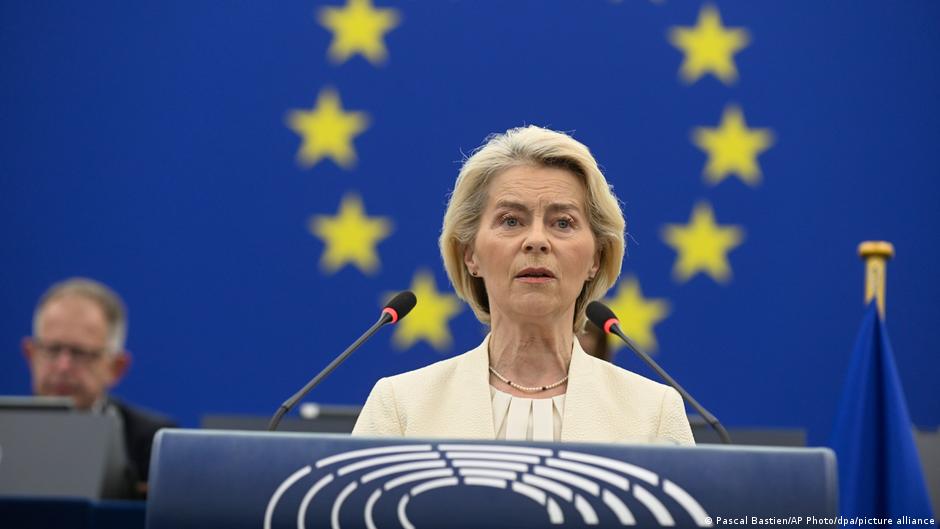
The European Union is preparing to allocate additional financing to Kyiv in mid-October for the purchase of drones and missiles, a move that underscores how Ukraine’s defense needs are increasingly being treated in Brussels as both a security priority and a long-term strategic investment. European Commission President Ursula von der Leyen announced the plan on Sunday, October 11, in a post on X following a phone call with Ukrainian President Volodymyr Zelensky.
Von der Leyen said the funding was needed to strengthen Ukraine’s defense and protect its airspace. She did not specify the amount of the financing or identify its sources, leaving open key questions for governments, defense contractors and financial planners watching how the EU intends to structure the next phase of its support.
“This is necessary to strengthen Ukraine’s defense and protect its airspace,” von der Leyen said.
The announcement comes as the situation in Ukraine is expected to be one of the central topics at this week’s European Council meeting. According to Brussels, leaders plan to discuss Ukraine’s financing needs for the coming year and ways to mobilize new international support. The agenda also includes the unblocking of two new clusters of topics in Ukraine’s negotiations with the EU, linking the security discussion with the broader political and institutional process of European integration.
A Defense Decision With Corporate Implications
For the European defense industry, the planned allocation reinforces a clear procurement trend: drones, missiles and air-defense-related capabilities remain at the center of Ukraine’s immediate demand profile. While the Commission has not disclosed the amount or sourcing of the new funds, the emphasis on drones and missiles points to a market in which fast production cycles, scalable supply chains and cross-border industrial coordination are becoming critical competitive factors.
The decision also reflects a management challenge for EU institutions. Brussels is balancing emergency military requirements with multi-year budget architecture, accession negotiations and political consensus among member states. By placing Ukraine on the European Council agenda alongside financing needs and international support, the Commission is signaling that aid to Kyiv is no longer managed as a series of isolated crisis responses. It is increasingly being organized as a continuing strategic program.
That distinction matters for corporate planning. Defense suppliers and technology firms across Europe need predictable demand, clear procurement channels and confidence that funding will survive political cycles. The lack of detail on the size and sources of the new allocation limits immediate visibility, but the timing and language from Brussels suggest that EU institutions are trying to keep the pipeline of support active while larger financing questions are negotiated.
Ukraine Facility as a Financing Framework
The new funding follows a separate decision on October 2, when the European Commission approved a 2.9 billion euro tranche for Kyiv under the Ukraine Facility. That mechanism was created to provide long-term financial assistance to Ukraine and is designed to run from 2024 through 2027. Over that period, the EU has said it can provide Ukraine with up to 50 billion euros in stable and predictable financial support.
The Ukraine Facility is not simply a cash-transfer instrument. Payments are closely tied to Ukraine’s implementation of a specific recovery and reform plan, as well as support for democratic mechanisms, the rule of law and human rights. According to the Commission, payments are made quarterly after verification that the conditions for disbursement have been met.
From a business perspective, this structure matters because it combines fiscal support, reform conditionality and macroeconomic stabilization. The EU’s emphasis on quarterly verification creates a governance model that can reassure donors and investors, but it also imposes execution pressure on Kyiv. Ukraine must continue to meet reform benchmarks while fighting a war and managing severe infrastructure and defense needs.
The planned discussion of financing needs for the coming year may therefore shape not only public-sector support, but also the broader competitive landscape for companies involved in reconstruction, energy infrastructure, logistics, cybersecurity and defense manufacturing. The clearer the EU’s multi-year support framework becomes, the easier it is for firms to assess demand, risk and partnership opportunities.
Ceasefire Call and Energy Security
Von der Leyen also said she fully supported Zelensky’s call for a ceasefire that would help protect global food supplies and energy infrastructure in Ukraine and Russia. That framing links the war directly to international commodity flows and infrastructure stability, issues of central concern to businesses exposed to agriculture, energy and transport markets.
Her comments suggest Brussels sees the conflict not only as a military and political crisis, but also as a disruption to global supply chains. Food security and energy infrastructure have become recurring themes in the EU’s Ukraine policy because damage to production, storage, transmission and export systems can have consequences far beyond the battlefield.
The Commission president described the war as having entered a new, even darker phase. She said Russia is conducting a protracted war on the battlefield and striking civilians far beyond the front line. That assessment helps explain the focus on airspace protection and long-range defensive capabilities. For EU leaders, the strategic question is not only how to sustain Ukraine’s state finances, but how to help the country defend critical systems against continued attacks.
For Kyiv, the additional drone and missile financing may provide another layer of military resilience at a time when air defense and strike capabilities are central to operational planning. For Brussels, it is also a test of institutional coordination: aligning Commission decisions, European Council deliberations, accession negotiations and international fundraising around a conflict that shows no sign of near-term resolution.
The coming European Council meeting will therefore be watched for more than diplomatic language. Governments, defense companies, infrastructure investors and Ukraine’s international partners will be looking for signals on the durability of EU support, the scale of future financing and the mechanisms Brussels may use to mobilize additional backing. The latest announcement does not answer all of those questions, but it confirms the direction of travel: Ukraine’s defense, recovery and integration are being folded into a single long-term European strategy.