Germany’s Anti-Extremism Protests Signal Rising Political Risk for Business
Mass demonstrations across more than 35 German cities highlight how the AfD’s electoral momentum is reshaping corporate risk calculations.
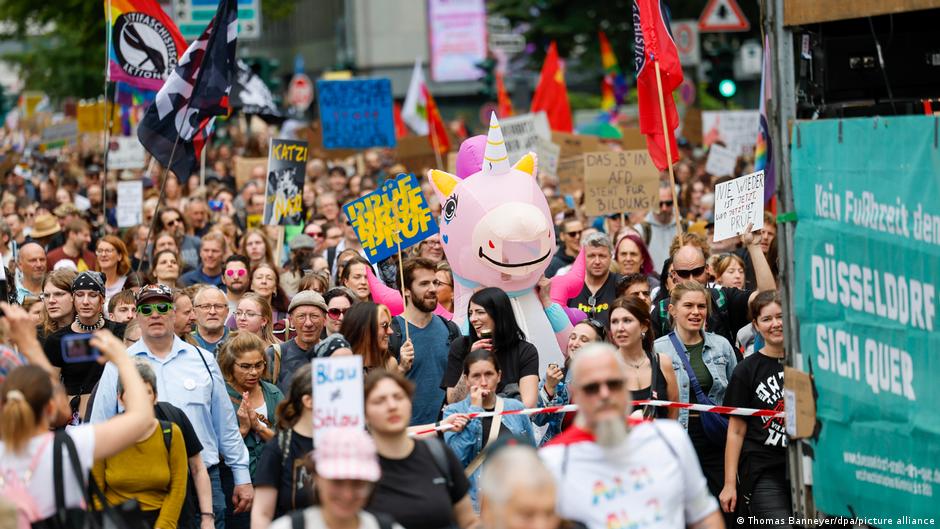
Mass demonstrations against right-wing extremism swept across more than 35 German cities on September 12, underscoring a political environment that is becoming harder for companies, investors and trade groups to treat as background noise. The protests came one week after the far-right Alternative for Germany, or AfD, won state elections in Saxony-Anhalt, a result that sharpened debate over the party’s legal status, its market impact and the durability of Germany’s political consensus.
For business leaders, the scale and distribution of the demonstrations matter. They were not limited to one capital-city rally or a symbolic gathering by activist groups. More than 100 associations were involved in organizing the protests, and turnout estimates showed sizable participation across major commercial and administrative centers. In Hamburg, organizers put attendance at 25,000. In Düsseldorf, roughly 20,000 people took part, a figure also confirmed by local police. In Berlin, law enforcement estimated 18,000 demonstrators. ARD, Germany’s public broadcaster, reported 12,000 participants in Munich, while about 2,000 turned out in Mainz.
The numbers were smaller but politically meaningful in several regional capitals. About 1,100 people demonstrated in Magdeburg, the capital of Saxony-Anhalt. Saarbrücken saw 1,500 participants, Erfurt several hundred, and Schwerin, the capital of Mecklenburg-Vorpommern, several dozen. The Schwerin protest was especially notable because it took place a week before local elections in Mecklenburg-Vorpommern, where polls also show the AfD in the lead.
Political Volatility Becomes a Corporate Planning Issue
Germany’s export-led economy depends on predictability: stable coalition politics, reliable institutions, strong regional administrations and a broadly pro-European policy framework. The AfD’s rise challenges that operating environment not necessarily through immediate legislative power, but through uncertainty. Companies planning capital expenditure, hiring, supplier networks or public-sector partnerships increasingly have to assess how regional election outcomes could affect regulation, labor markets, procurement priorities and Germany’s appeal to international talent.
That concern is particularly relevant in eastern German states, where the AfD has built momentum and where industrial policy, infrastructure spending and workforce development remain central to economic strategy. A far-right party’s electoral success can alter boardroom calculations even before it enters government. Management teams must consider employee relations, reputational exposure, site-selection risk and how customers abroad interpret political change in Germany.
The protests also showed that civil society organizations are treating the AfD’s ascent as an institutional issue rather than only a partisan contest. In several cities, including Munich, Mainz, Saarbrücken and Magdeburg, demonstrations took place as part of the Prüf campaign. The campaign calls for careful scrutiny of parties classified by the Federal Office for the Protection of the Constitution, known as the BfV, as either suspected of right-wing extremism or definitively right-wing extremist.
Prüf translates as “check,” and organizers present it as an acronym for “Prüfung Rettet Übrigens Freiheit,” meaning “scrutiny, by the way, saves freedom.”
The campaign’s framing is significant for corporate Germany because it casts institutional due diligence as a democratic safeguard. That language resonates with a business culture built around compliance, risk control and regulatory process. The demand is not simply for political opposition to the AfD, but for formal examination of whether the party should remain within the bounds of normal political competition.
Ban Debate Adds Legal and Strategic Uncertainty
At several rallies, demonstrators called for the launch of proceedings to ban the AfD. In May 2025, the BfV classified the party as right-wing extremist at the federal level. That classification, however, is not currently in effect because of a lawsuit filed by the party. This creates a legally ambiguous environment: the classification carries political weight, but its practical application remains suspended while the court process continues.
For companies, this legal uncertainty complicates stakeholder management. Business associations, employers and multinational firms must decide how publicly to position themselves on democratic norms, anti-extremism commitments and cooperation with political actors. A clear court-backed classification could simplify some decisions. A prolonged legal dispute, by contrast, leaves executives navigating a sensitive landscape where silence, engagement and public condemnation each carry risk.
The slogans used in major cities indicate how strongly the issue is being framed as a defense of democratic institutions. In Düsseldorf, demonstrators marched under the slogan “Kein Schritt zurück! Gegen die AfD und rechte Hetze!” or “Not one step back! Against the AfD and right-wing agitation.” In Hamburg, the message was “Zeit zum Handeln - Freiheit muss verteidigt werden,” meaning “Time to act - freedom must be defended.”
Those slogans may sound distant from balance sheets, but they point to a broader operating question: whether Germany’s political center can maintain the informal rules that have long shaped coalition-building and administrative continuity. One of those rules is the so-called firewall policy toward the AfD, under which other parties refuse to cooperate with it. A recent INSA poll conducted on September 10 and 11 showed that this firewall is itself under pressure. Almost half of Germans, 46%, opposed the policy, while 34% supported maintaining the barrier and 20% were undecided.
The same INSA poll found a divided public on the question of banning the AfD: 42% supported the idea, while 45% opposed it. That split matters commercially because it suggests that any move against the party, whether legal or political, could deepen social polarization. Companies with broad consumer bases, large workforces or government exposure may increasingly face internal and external pressure over how they respond.
The demonstrations therefore mark more than a weekend of protest. They represent a warning signal for executives that Germany’s political risk profile is changing. The AfD’s electoral gains, the suspended BfV classification, public division over a ban, and weakening support for the firewall together create a more complex competitive landscape for businesses operating in Europe’s largest economy. Corporate strategy in Germany can no longer assume that political stability is a fixed input. It is becoming a variable that management teams may need to measure, model and communicate with the same seriousness as energy costs, labor shortages or supply-chain exposure.