German Military Refusal Filings Surge as Bundeswehr Recruitment Push Tests Strategy
A sharp rise in conscientious-objection filings highlights the management challenge behind Germany’s plan to expand the Bundeswehr by 2035.
Germany’s effort to rebuild military capacity is encountering an early and politically sensitive management challenge: a rapid increase in young people formally declaring that they do not want to serve in the armed forces. From January through the end of August 2026, at least 12,102 people filed statements refusing military service with the Federal Office for Family and Civil Society Affairs, known as BAFzA, according to the Funke media group, which reported the figures on Monday, October 5.
The scale of the increase is notable for defense planners and policymakers. In all of 2025, German authorities received 3,879 applications refusing military service. That means the number recorded in just the first eight months of 2026 was more than three times the total for the previous full year. The surge comes as Berlin is attempting to build a larger, more resilient military workforce without yet fully restoring compulsory service, which was suspended in 2011.
For the Bundeswehr, the figures point to a strategic tension familiar to large organizations trying to expand quickly: top-line recruitment indicators may improve, while resistance within the target labor pool also becomes more visible. The Defense Ministry has reported stronger personnel numbers and more applications for contract military service, but the rise in refusal filings suggests that the new recruitment system is also mobilizing opposition among some young Germans.
A Recruitment Reform With Corporate-Scale Execution Risks
The immediate trigger for the increase appears to be Germany’s new conscription reform law, which entered into force on January 1. Under the system, 18-year-old men are required from 2026 to complete a questionnaire asking whether they are willing to join Germany’s armed forces. Young people are also entitled to declare in advance that they refuse military service.
That administrative design has effectively created a broader funnel for the Bundeswehr, but also a clearer channel for opt-outs. In business terms, the state has expanded the top of its talent pipeline while simultaneously giving potential recruits a formal mechanism to signal non-participation. The result is more data, more engagement and more friction.
BAFzA said applications from objectors often contain errors and that their content does not meet the requirements for recognition as a justified refusal, meaning such applications have to be returned without consideration.
The processing burden matters. If a significant share of applications is incomplete or procedurally defective, the state faces not only a communications problem but an operational one. The refusal process must be clear enough for citizens to understand, while robust enough to withstand legal and political scrutiny. For an institution seeking to scale recruitment, administrative complexity can become a constraint in its own right.
The broader strategic backdrop is Germany’s changed security environment. The reform includes the possibility of partially reintroducing mandatory service by decision of the Bundestag. The proposed mechanism, described as a form of military obligation if necessary, is intended to be used if the country cannot reach the required number of volunteers. The Defense Ministry’s planning target is for as many as 260,000 people to be serving in the Bundeswehr at the same time by 2035.
Brand, Labor Market and Public Resistance
The Bundeswehr has been broadening the places where it looks for new recruits, including by setting up a stand at Gamescom, one of the world’s largest video game trade fairs, held in Cologne. That strategy reflects a competitive labor-market reality: defense institutions are increasingly competing with civilian employers for the attention of young people with technical skills, digital fluency and long-term career options.
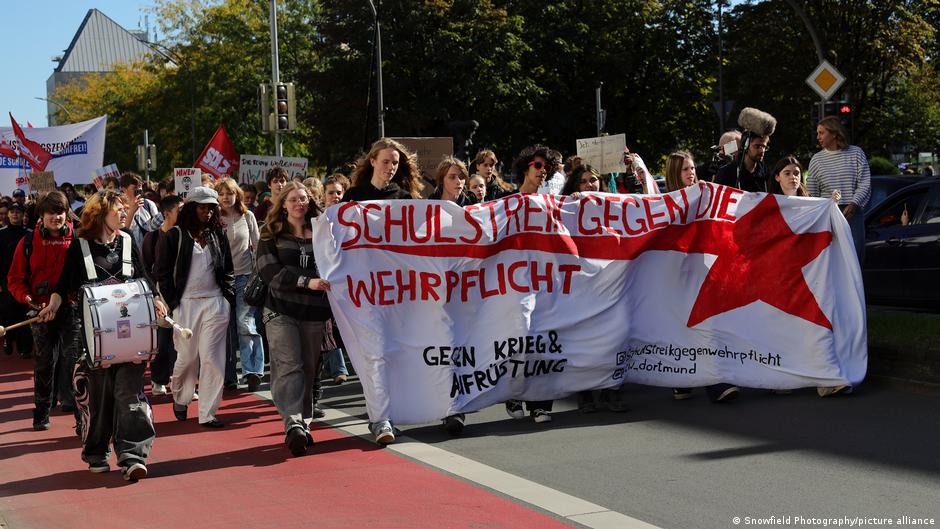
But the same outreach can sharpen reputational risk. German school students have criticized the possible return of military obligation if necessary, and large protests took place in several German cities in September. For the Bundeswehr, the issue is not simply whether it can recruit more people; it is whether it can do so while maintaining legitimacy among the very demographic it is trying to attract.
The ministry can point to momentum. At the end of July 2026, Germany’s Defense Ministry reported that Bundeswehr personnel had reached the highest level in 13 years, with 186,700 service members. Compared with July 2025, that represented an increase of more than 2 percent, or 3,700 service members.
The questionnaire campaign has also produced measurable throughput. Of roughly 378,000 people who had been sent questionnaires since the beginning of 2026, about 2,630 completed the assessment procedure for service suitability in July alone. That was 35 percent more than in the previous month. By that point, around 12,100 volunteers and short-term contract soldiers were already serving under the new recruitment system, about 6 percent more than a year earlier.
The Defense Ministry also recorded a substantial increase in applications and admissions for contract military service. In July 2026, 47,300 people submitted such applications, 26 percent more than in the same month of the previous year. By the end of July, the number of new recruits stood at 15,400, a 12 percent increase compared with 2025.
Taken together, the data show a mixed but strategically important picture. Germany is generating more interest in military service and increasing Bundeswehr headcount, but it is also provoking a much larger volume of formal refusal declarations. For defense leadership, that combination creates a management challenge resembling a large-scale workforce transformation: expand the candidate pool, protect institutional reputation, simplify administrative procedures and sustain political support.
The central business question for Germany’s defense establishment is whether the recruitment model can convert outreach into durable staffing gains faster than public resistance and procedural bottlenecks erode momentum. The Bundeswehr’s 2035 target remains ambitious. The 2026 figures suggest that the path toward it will depend not only on security policy, but on execution discipline, communications strategy and the institution’s ability to compete for young people in a contested labor market.