Georgia’s Renewed Protests Raise Risks for Business and EU Strategy
Opposition leaders are mobilizing against Georgian Dream as a court considers banning parties and a major demonstration approaches.
Georgia’s opposition has declared the start of a new wave of protests against the ruling Georgian Dream party, adding another layer of political risk for companies and investors assessing the country’s strategic direction, governance environment and ties with the European Union.
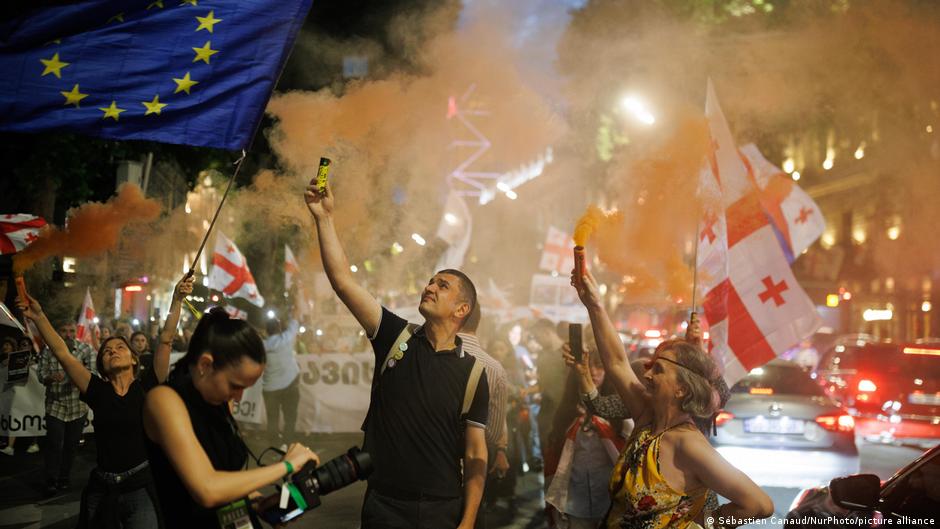
Thousands of people joined a protest march in Tbilisi on Sunday, October 25, according to Caucasian Knot. Organized by opposition representatives and civil society groups under the slogan “Georgia Without Ivanishvili,” the demonstration took place as Georgia’s Constitutional Court considers a lawsuit seeking to ban opposition parties.
Participants marched from Tbilisi State University toward Rustaveli Avenue, carrying the flags of Georgia, Ukraine and the European Union. Caucasian Knot also reported a substantial presence of security personnel at the event.
The political confrontation is becoming an increasingly important element of Georgia’s business outlook. Although the march was focused on democratic governance rather than economic policy, the dispute concerns the durability of institutions, the competitive political landscape and the country’s long-term alignment with European markets. For management teams, lenders and potential acquirers, those factors can influence risk assessments, capital allocation and decisions about establishing or expanding operations in Georgia.
Opposition sets November 28 as a key mobilization date
Nika Gvaramia, leader of the Coalition for Change, described Sunday’s rally as the beginning of a new protest wave. He said the movement would need to build toward a culmination, potentially on November 28—the second anniversary of the start of mass protests in Georgia—or in the days that follow.
“We are starting today, and we definitely need a culmination, whether it is November 28 or in the following days. It is important that there are very many of us on the 28th, so that the wind cannot extinguish the fire,” Gvaramia said, as quoted by Caucasian Knot.
A large demonstration is planned for November 28. Gigi Tsereteli, leader of European Georgia, who also attended the march, portrayed the political dispute as a sharp reversal in the country’s European integration trajectory.
“What is happening in Georgia today in terms of the destruction of democracy and disruption is truly unimaginable against the background that we were a champion country on the path of European integration, while today we are outsiders,” Tsereteli said, according to Georgia Online. He added that parties were being banned, political life was effectively being restricted and the issue of political prisoners represented another significant challenge.
The Constitutional Court proceedings have therefore become a central strategic issue for the opposition. Any ban on political parties would reshape the country’s competitive political field and could deepen questions about institutional predictability. From a business perspective, prolonged uncertainty may complicate long-range planning, particularly for companies whose investment cases depend on closer integration with the EU, stable regulation and confidence in independent institutions.
Political crisis tests Georgia’s market positioning
The current protest movement traces its origins to mass demonstrations against the “foreign agents” law in spring 2024. Protests intensified after Georgian Dream won the parliamentary elections and developed into a broader crisis in November of that year, when the authorities decided to postpone talks on Georgia’s accession to the European Union until 2028.
Those demonstrations were accompanied by clashes with police, while security forces dispersed protesters using tear gas and water cannon. The renewed mobilization now raises the possibility that political confrontation will again dominate Georgia’s public agenda as the November 28 rally approaches.
For Georgian Dream, the challenge resembles a high-stakes strategic management test: it must maintain control of the political process while addressing opposition pressure and the consequences of its EU policy. The opposition, meanwhile, is attempting to convert fragmented dissatisfaction into sustained mobilization around a clear date and a shared message.
The stakes extend beyond domestic party politics. Georgia has historically marketed itself as a bridge between Europe and the wider region, making its international alignment an important part of its competitive proposition. A prolonged dispute over democratic standards and EU integration could weaken that positioning, even without an immediate change in economic policy.
There is no indication in the source material that specific transactions, companies or investment projects have yet been affected. Still, corporate decision-makers typically monitor political stability, regulatory continuity and access to major markets when evaluating acquisitions or expansion. The opposition’s new campaign, the court case over party bans and the planned November demonstration give them three closely connected developments to watch.
The scale of participation on November 28, the authorities’ response and the Constitutional Court’s handling of the lawsuit will help determine whether the new protest wave becomes another prolonged national crisis or remains a series of opposition-led demonstrations. Either outcome will shape perceptions of Georgia’s governance and strategic direction.