Italy Protests Raise Security and Operating Risks for Businesses
Demonstrations over living costs and government policy forced retailers and transport hubs to strengthen security across major Italian cities.
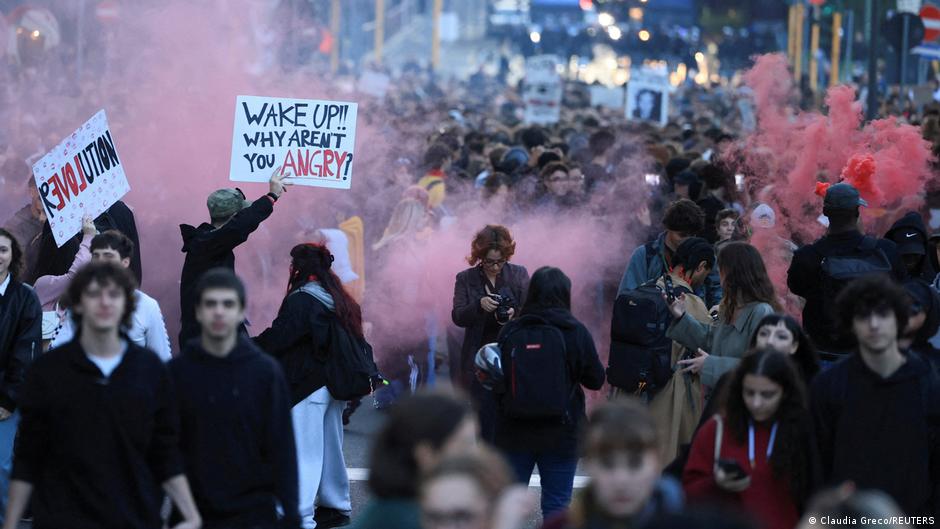
Protests over Italy’s high cost of living continued on Saturday, October 24, creating fresh operating and security challenges for retailers, transport infrastructure and other businesses in the country’s largest cities. The demonstrations also targeted rising fuel prices, increased armament spending and the policies of Prime Minister Giorgia Meloni’s government.
Police reported nine arrests and 371 preliminary detentions, including 110 involving minors, according to AFP. The distinction between arrests and preliminary detentions is significant: the figures indicate that authorities intervened on a broad scale, even though the number of formal arrests reported was considerably lower.
For corporate management teams, the demonstrations underline how pressure on household budgets can spread beyond consumer sentiment and become a direct operational concern. Public unrest can disrupt customer traffic, employee travel and logistics while raising security expenses for businesses located near city centers, railway stations and other likely gathering points.
Luxury retailers protect stores in central Milan
In Milan, demonstrations remained largely peaceful until the evening, according to dpa. Protesters and law enforcement officers nevertheless clashed in the city center after police stopped a column of demonstrators and used batons.
Fearing renewed disorder, the owners of many luxury stores barricaded their windows. The defensive action illustrates the immediate decisions facing retailers when protests move through premium shopping districts: keeping premises visible and accessible must be weighed against the risk of property damage, interruptions to trading and danger to staff or customers.
Luxury businesses have an especially visible presence in central Milan, making storefront protection an important part of short-term crisis management. Even without confirmed damage, barricaded windows can affect the shopping environment and signal elevated risk to visitors. Management teams must therefore balance physical security with brand presentation and commercial continuity.
For companies operating in prominent urban locations, the protests have turned political and social tensions into practical decisions about security, staffing and access.
The authorities had already reinforced security after protests on October 17 and 18 escalated into disorder. Italy sent 500 members of elite military units to Milan. The government also simplified procedures for detaining minors and for imposing financial penalties on their parents when property is damaged.
Drones and helicopters were deployed to monitor demonstrations, while patrols at railway stations were increased. Authorities also closely tracked online activity to identify new calls for unrest. Taken together, the measures show a strategy centered on deterrence, surveillance and rapid intervention following the earlier disturbances.
Transport access becomes a central pressure point
Rail infrastructure was a particular focus in Bologna, where police used tear gas and water cannons to prevent a column of demonstrators from approaching the railway station. In Turin, law enforcement officers used shields to push protesters back.
Such confrontations matter to companies well beyond the transport sector. Railway stations are important links for commuters and intercity movement, so restricted access or intensified policing can complicate workforce planning and business travel. Companies exposed to city-center disruptions may need contingency plans for employee access, deliveries and temporary closures if demonstrations continue.
In Rome, a predominantly pro-Palestinian demonstration moved through the historic center. At one point, participants entered the Colosseum, dpa reported. Protests were also held in Naples and Florence, demonstrating that the unrest was not confined to one commercial center or region.
Cost pressures broaden the corporate risk agenda
The range of grievances complicates the response for both government and business. Demonstrators linked the cost of living and fuel prices with military spending, foreign-policy concerns and opposition to Meloni’s administration. That combination means the protests cannot be treated solely as a short-lived reaction to one price increase or one policy decision.
For companies, the competitive effects are likely to depend on location, customer profile and operational flexibility. Businesses able to adjust opening hours, protect premises and communicate quickly with employees may be better positioned to maintain continuity. Smaller operators and stores dependent on spontaneous city-center traffic may have fewer options when streets are blocked or customers stay away.
The unrest also highlights the strategic importance of monitoring social and political risks alongside conventional commercial indicators. Consumer-facing groups already dealing with sensitivity to living costs must now consider whether public dissatisfaction could translate into weaker footfall, additional security requirements or recurring disruption.
Italy’s reinforced security response may reduce the likelihood of serious damage, but it can also produce confrontations when police prevent marches from reaching sensitive locations. The events in Milan, Bologna and Turin show how quickly largely peaceful demonstrations can generate operational consequences once routes intersect with retail districts or transport hubs.
With protests occurring across Milan, Bologna, Turin, Rome, Naples and Florence, management teams face a geographically dispersed risk rather than an isolated local event. The immediate corporate priority is continuity and employee safety. The longer-term question is whether persistent pressure from living costs and fuel prices will continue to affect consumer confidence, urban commerce and the broader business environment.