MYRA Distress Call Exposes Risks Facing Sanctioned Oil Shipping Networks
The tanker’s Atlantic emergency highlights the operational and regulatory pressures surrounding opaque Russian and Iranian oil-trading structures.
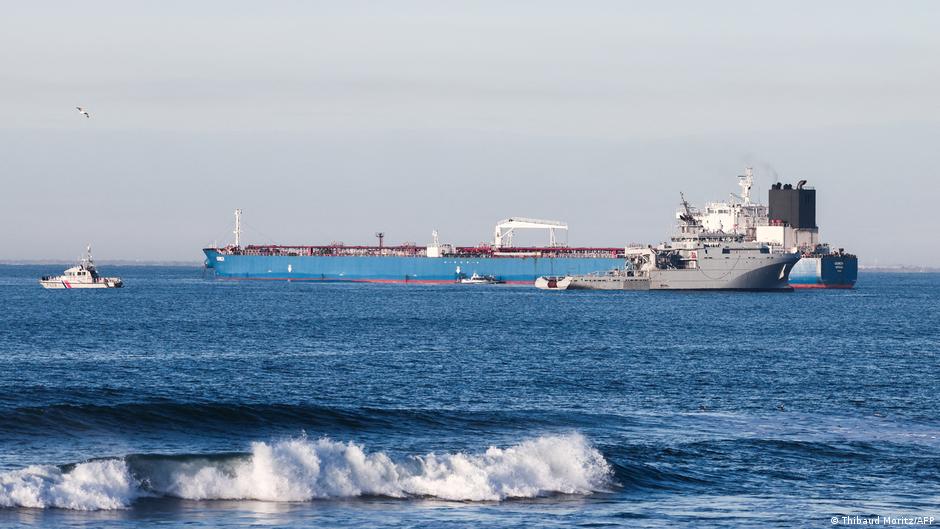
The sanctioned oil tanker MYRA has issued a distress signal in the North Atlantic off Ireland’s northwestern coast, drawing attention to the operational risks confronting the shipping networks used to move Russian and Iranian oil outside conventional Western-controlled trade channels.
Maritime monitoring project SeaNews reported on Saturday, October 24, that the distress signal was transmitted through the Inmarsat-C satellite communications system. The UK Coastguard is coordinating the response to the tanker, which remains about 348 kilometers from the coast.
Despite the emergency and extreme weather, the 75,000-ton vessel was continuing to travel at approximately 9 knots, equivalent to about 17 kilometers per hour. SeaNews said waves in the area reached 8.8 meters around the time of the alert, while wind gusts were approximately 130 kilometers per hour. The tanker had departed from the Russian port of Ust-Luga.
Sanctions Raise the Cost of Managing Maritime Risk
MYRA is subject to sanctions imposed by the United States, European Union and United Kingdom, among other jurisdictions. For businesses involved in sanctioned maritime trade, an emergency can expose structural vulnerabilities that remain less visible during routine voyages. A distressed ship may require assistance from coastguards, salvage providers, insurers, port authorities or other counterparties operating under strict compliance rules.
The incident therefore carries significance beyond the fate of a single tanker. Operators of so-called shadow fleets must manage aging or otherwise commercially isolated assets across long routes while navigating sanctions that can restrict access to mainstream financing, insurance and maritime services. Severe weather compounds those pressures by turning questions of vessel management and corporate accountability into immediate safety concerns.
According to War & Sanctions, a database maintained by the Main Intelligence Directorate of Ukraine’s Defense Ministry, or HUR, MYRA has been used to export Russian crude oil and petroleum products to third countries in circumvention of sanctions. Ukrainian intelligence links the vessel to Fractal Marine DMCC, a company registered in the United Arab Emirates that HUR describes as one of the leading operators of Russia’s shadow fleet.
The vessel’s emergency illustrates how sanctions compliance, corporate opacity and physical shipping risk can converge far from the ports where a cargo originates.
HUR says MYRA has repeatedly called at the Russian ports of Ust-Luga and Primorsk. It has also visited ports in Senegal, Turkey, Brazil, Estonia and Denmark. That geographic reach demonstrates the international footprint of tanker operations associated by Ukrainian intelligence with sanctioned Russian energy exports.
A Layered Network Linking Russian and Iranian Oil
The chronology of sanctions shows how regulatory pressure accumulated across major Western jurisdictions. The War & Sanctions database states that the United States designated MYRA on July 30, 2025, followed by the European Union on October 24, 2025. Switzerland and Ukraine added the vessel to their sanctions lists on December 13, 2025. The United Kingdom imposed sanctions on February 24, 2026, and Canada followed on March 25, 2026.
For tanker operators and their commercial partners, such staggered designations can progressively narrow the pool of available counterparties. Each additional jurisdiction may affect access to services, ports or corporate relationships, increasing the importance of ownership structures and operational intermediaries. MYRA’s continued activity after multiple designations shows how these networks can remain commercially active even as their formal options contract.
Ukrainian intelligence alleges that MYRA belongs to the shipping network of Mohammad Hossein Shamkhani. He is the son of Ali Shamkhani, Iran’s former secretary of the Supreme National Security Council and a former adviser to the country’s supreme leader. Ali Shamkhani was killed in a joint US-Israeli operation in February 2026.
According to HUR’s assessment, the younger Shamkhani controls a network of tankers, operators and shell companies used for money laundering and the transportation of Russian and Iranian oil, including supplies bound for China. The allegation places MYRA within a business structure that connects sanctioned producers with large end markets through layers of vessels and corporate entities.
From a competitive standpoint, such structures allow sanctioned exporters to keep serving international buyers, but they also create management challenges. Responsibility can be distributed across registered owners, operators and associated companies, while the vessels themselves must continue operating across multiple jurisdictions. That arrangement may provide commercial flexibility, yet it can complicate oversight when a ship faces a technical or weather-related emergency.
The distress call does not by itself establish the precise nature of MYRA’s problem, and SeaNews reported that the ship was still moving. Nevertheless, the episode puts an operational spotlight on a tanker already at the center of sanctions enforcement and intelligence scrutiny. Its outcome will be relevant not only to maritime authorities but also to companies assessing exposure to opaque oil-shipping networks, the resilience of sanctions-circumvention strategies and the competitive durability of trade routes connecting Russian and Iranian supply with buyers in third countries.