White House Says U.S. Envoys Discussed Concrete Ukraine Plans With Putin
The Moscow meeting places Trump’s diplomatic initiative at a sensitive point between strategic bargaining, alliance management and battlefield leverage.
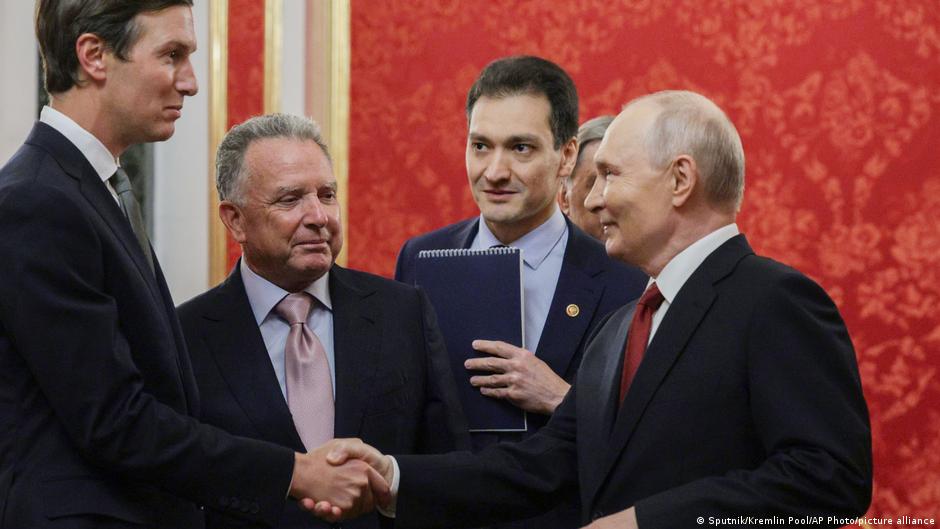
The White House said U.S. representatives Stephen Witkoff and Jared Kushner discussed “concrete plans” with Russian President Vladimir Putin for the next steps toward ending the war in Ukraine, setting up a first visit by the two envoys to Kyiv for talks with Ukrainian President Volodymyr Zelensky.
A White House representative told AFP overnight on Sunday, September 6, that Witkoff, a special envoy of U.S. President Donald Trump, and Kushner, Trump’s son-in-law, had reviewed specific plans during their meeting with Putin. Those plans, according to the same account, are expected to be made public “in the coming weeks.” The White House source said the U.S. envoys were looking forward to “no less productive meetings” in Ukraine.
For businesses, investors and governments watching the conflict’s impact on energy markets, defense procurement, reconstruction planning and sanctions exposure, the reported initiative is significant less because of the limited details disclosed than because of the cast of decision-makers involved. The talks place a small group of Trump-linked negotiators at the center of a high-stakes diplomatic process involving Moscow, Kyiv and Washington, with potentially wide consequences for the European security and commercial landscape.
Trump also announced a new diplomatic initiative to end the war and said Witkoff and Kushner had brought with them a plan “to end the war,” AFP reported. He did not specify whether the plan would involve transferring Ukrainian territories to Russia. Trump said only: “We have an idea for peace.”
Negotiating Sequence Moves From Moscow to Kyiv
After the Moscow visit, Kushner and Witkoff are due to arrive in Kyiv for their first talks with Zelensky. Flight-tracking data from Flightradar24 showed that a Boeing C-32A carrying the U.S. special envoys landed at 01:30 local time at the airport in Rzeszow, Poland. The aircraft had departed from Moscow’s Vnukovo airport, headed west while bypassing Belarus, and then crossed the airspace of Latvia, Lithuania and Poland. The U.S. representatives are expected to continue to the Ukrainian capital by train.
The route itself reflects the operational realities surrounding wartime diplomacy. Ukraine’s airspace remains constrained by the conflict, and Poland’s Rzeszow has become a key logistical point for official travel and support flows linked to Ukraine. For companies involved in logistics, security, infrastructure and defense supply chains, the movement of senior negotiators through established wartime corridors underscores how diplomacy and operational support networks now overlap.
Moscow described the meeting with Putin as “extremely frank.” Yuri Ushakov, an aide to the Russian president, told Russian journalists that the U.S. delegation had presented “several ideas” on how the war in Ukraine could be brought to an end.
“American representatives prepared thoroughly for this trip,” Ushakov said, adding that they expressed interest in a rapid end to hostilities and presented possible routes toward a settlement.
Ushakov, quoted by Interfax, said the talks were timely and useful for both sides. He also said Putin had confirmed his readiness to continue working with the Americans in search of political and diplomatic outcomes.
Strategic Stakes for Washington, Moscow and Kyiv
From a corporate strategy perspective, the emerging initiative resembles a concentrated negotiation process in which access, timing and information control matter as much as formal institutions. Trump’s reliance on Witkoff and Kushner signals a management style centered on trusted personal channels rather than a broad, publicly structured diplomatic framework. That can accelerate decision-making, but it can also raise questions among allies and market participants about durability, governance and implementation risk.
For Moscow, the talks provide an opportunity to present its military and political position directly to Trump’s emissaries. According to RBC, the Russian side gave the Americans its assessment of the course of military operations in Ukraine, noting successes by the Russian army and expressing confidence in achieving its stated objectives. RBC reported that Trump’s special envoys promised to use that information during their negotiations in Kyiv.
That detail is important for the competitive landscape around any possible settlement. Russia appears to be positioning battlefield momentum as leverage in negotiations, while Ukraine will seek to shape the U.S. team’s understanding of its own security needs, territorial red lines and political constraints. The sequencing of meetings, first in Moscow and then in Kyiv, may also affect perceptions among European governments and private-sector stakeholders assessing whether the process is balanced and enforceable.
Zelensky held a phone call the previous day with the U.S. presidential envoys while they were in Russia. He announced readiness to halt strikes on Moscow for the next three days. In a social media post, Zelensky said the plan for diplomatic measures in Kyiv involving the American team had been approved, and that Ukraine was awaiting Steve Witkoff and Jared Kushner for a substantive conversation.
For companies exposed to the region, the immediate business implications remain uncertain. No terms have been disclosed, and Trump has not clarified whether territorial concessions are part of the proposal. Until the plan is published, decision-makers in energy, agriculture, transport, insurance, construction and defense will have limited basis for changing assumptions. Still, the announcement of “concrete plans” suggests that Washington is moving from general statements about ending the war toward a more defined negotiating product.
The next stage in Kyiv will therefore be decisive. If the U.S. envoys present a plan that Ukraine views as politically viable, the process could move into a more structured phase with implications for sanctions policy, reconstruction financing and regional risk premiums. If the proposal is seen as too aligned with Moscow’s position, it could deepen friction between Kyiv, Washington and European partners, complicating the investment and security environment further.
For now, the White House is framing the Moscow talks as productive and expects further progress in Ukraine. Moscow is emphasizing frank discussion and continued diplomatic work. Kyiv is signaling readiness for a serious meeting while making a short-term gesture on strikes against Moscow. The business world will be watching whether those positions converge into an executable plan or remain part of a broader contest for leverage.