Trump Commends Zelensky’s Resilience in Russia-Ukraine Conflict Amid Shifting US-European Relations
Former US President Donald Trump praises Ukrainian President Zelensky's handling of the ongoing war while expressing frustration with European allies' stance.
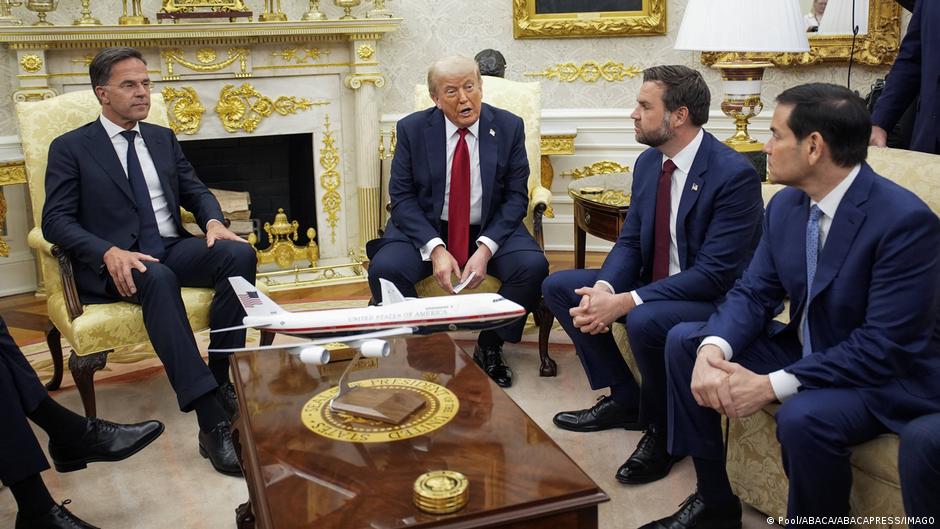
During a press conference at the White House on June 24, former US President Donald Trump expressed rare commendation for Ukrainian President Volodymyr Zelensky’s conduct amid the ongoing conflict with Russia. Trump acknowledged the significant human cost on both sides but noted that Zelensky is "holding his own" and that things are "going pretty well" from the Ukrainian perspective.
Trump’s Shift on Zelensky and the Geopolitical Context
Trump’s remarks marked a notable departure from his previous criticism of Zelensky, during which he accused the Ukrainian leader of impeding peace efforts. This evolution in tone may reflect broader shifts in the strategic landscape as the war enters its fifth year.
“At least he’s holding, and I think things are going pretty well for him,” Trump stated in response to a journalist’s question about whether Zelensky is winning.
Despite praising Zelensky, Trump did not shy away from expressing dissatisfaction with key European allies, particularly Germany. He lamented the German government’s refusal to extend even minimal support analogous to "a small kiss," a metaphor for closer cooperation or concessions, especially concerning the US and Israel’s stance against Iran.
Trump underscored the substantial US financial commitments toward stationing American troops in Germany and other European countries, lamenting Europe’s reluctance to reciprocate adequately in diplomatic or strategic cooperation.
These comments came in the wake of the recent G7 summit held in France from June 15 to 17, where enhanced sanctions against Russia were agreed upon. During the summit, Trump met with Zelensky and other G7 leaders, describing the meeting as "very good." He reiterated his belief that Russia should negotiate peace with Ukraine and pledged to do everything in his power to facilitate such an outcome.
The context is complex given that last year’s Oval Office meeting between Trump and Zelensky was marked by tension and skepticism over Zelensky’s leverage in peace negotiations. Reuters noted this contrast, highlighting Trump's current optimistic stance in relation to the prolonged conflict.
On June 24, in a public address, Zelensky stated that with the assistance discussed at the G7 summit, Ukraine could promptly create conditions forcing Russia to choose peace. However, he did not elaborate on the specific mechanisms or strategies underlying this assertion.
Business and Strategic Implications
Trump’s comments spotlight the evolving dynamics among Western powers and their approach to the Russia-Ukraine conflict, which has significant implications for international defense cooperation, economic sanctions, and geopolitical alliances.
For corporations and investors, the fluctuating US-European relations and the US’s assertive posture could influence transatlantic trade policies, defense contracts, and broader market stability. The US’s expectation for greater European alignment might prompt shifts in strategic partnerships and investment flows, especially in sectors tied to national security and energy.
Moreover, the prospect of renewed peace negotiations, as encouraged by Trump, may alter risk assessments for companies operating in Eastern Europe and impact supply chains disrupted by the conflict.