Spain’s Transport Minister Resigns After Deadly Toledo Rail Crash
Óscar Puente’s departure puts rail safety, infrastructure oversight and government crisis management under renewed scrutiny.
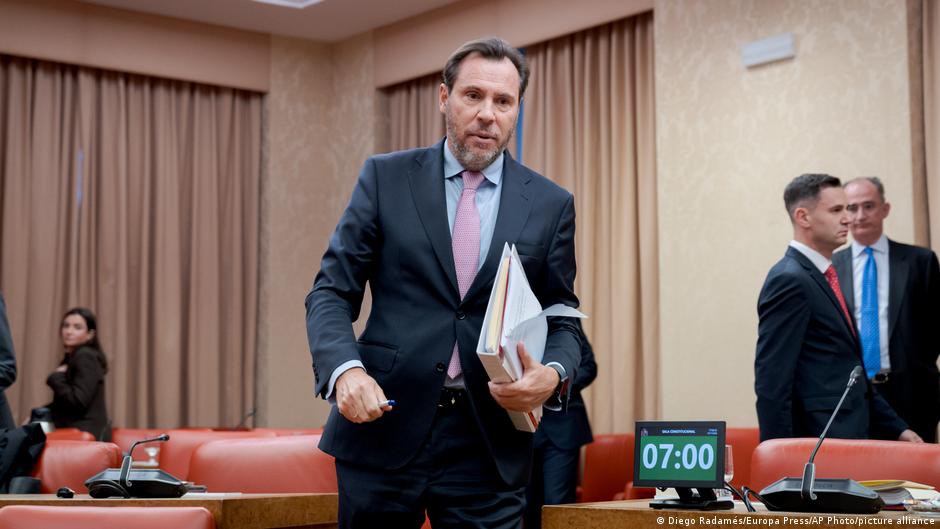
Spain’s transport minister, Óscar Puente, has resigned and withdrawn from the country’s early parliamentary elections following a railway disaster near Toledo that killed 69 people, a decision that intensifies scrutiny of the government’s management of the national rail system.
Puente announced his departure on Tuesday evening, November 3, while appearing before a parliamentary commission in Madrid. The statement came almost a week after the collision and represented a reversal of his previous position, as both Puente and Prime Minister Pedro Sánchez had repeatedly ruled out his resignation.
“A minister cannot remain in office after two disasters of this magnitude in less than one year. It is a matter of political dignity, responsibility and political sensitivity,” Puente said.
All opposition parties had demanded that the minister step down. Even so, the announcement was unexpected because the government had consistently rejected that outcome before Puente’s parliamentary appearance. His decision to abandon an election bid as well as his ministerial position extends the consequences beyond the transport portfolio and into the government’s broader political strategy.
A leadership reversal amid mounting operational pressure
The resignation highlights the management risks that emerge when repeated operational failures become inseparable from political accountability. Spain has recorded seven railway disasters involving passenger casualties since the beginning of 2026. Two major crashes within the same year have now claimed a combined 115 lives and injured more than 200 people.
The latest accident occurred at 8:53 a.m. on October 28 near the town of Urda in Toledo province, on the Madrid-Seville high-speed line. Passenger train AVE 2080 struck the last carriage of Iryo 6076, which was stationary on the tracks. Sixty-nine people died and more than 50 were injured.
Another major collision took place on January 18 near Adamuz on the Madrid-Málaga high-speed route and involved two trains. That disaster killed 46 people, while another 150 sustained injuries of varying severity.
The two investigations are examining different potential failures. Damage to railway tracks is considered one possible cause of the Adamuz crash. The inquiry into the Urda accident, by contrast, is focused on the failure of the automatic train-protection system and possible errors in instructions issued by the traffic control centre.
That distinction matters for the rail sector’s management and competitive landscape. Track damage points toward questions about physical infrastructure and maintenance, while a protection-system failure and possible control-centre errors bring technology, operating procedures and human decision-making into focus. The investigation’s findings will therefore be central to determining where responsibility lies across Spain’s rail ecosystem.
Government combines executive change with financial response
Only hours before Puente announced his resignation, Spain’s government approved measures intended to improve railway safety. At its weekly cabinet meeting, it also authorised a €30 million assistance package for injured passengers and the families of those killed.
The timing places the resignation alongside an immediate operational and financial response. For government managers, the challenge will be to show that the new safety measures address the risks exposed by the accidents rather than serving only as a short-term reaction to public and political pressure. The assistance package provides support after the disaster, but the longer-term test will be whether institutional changes can reduce the likelihood of another failure.
Puente’s reversal may also affect confidence in crisis management at the top of the administration. By previously excluding a resignation and then stepping down under sustained opposition pressure, the minister has shifted the government’s position at a sensitive moment before early elections. His withdrawal from the contest removes him from both his executive role and the coming parliamentary campaign.
For companies operating in and around Spain’s rail market, the investigation could influence future priorities in safety technology, infrastructure maintenance, control systems and operational oversight. The source material does not identify any company as responsible for the crashes, and the causes remain under investigation. However, the focus on automatic protection and dispatch instructions makes the Urda inquiry particularly consequential for how responsibilities are assessed among public authorities and rail operators.
Accountability becomes a strategic issue
Puente framed his resignation as a question of political dignity and responsibility after two large-scale disasters in less than a year. That reasoning turns executive accountability into part of the government’s response, alongside safety measures and victim assistance.
The immediate political demand for his departure has now been met, but the underlying operational questions remain unresolved. Investigators must establish why the automatic protection system allegedly failed, whether traffic-control instructions contributed to the collision and how a passenger train was able to strike a stationary service on a high-speed route.
Until those findings are available, the resignation changes leadership but does not settle responsibility. Spain’s government and rail sector now face the more difficult management task of translating the lessons from Urda and Adamuz into credible safety improvements across a network that has suffered seven passenger-related disasters since the start of the year.