Khodorkovsky Urges Europe to Incentivize a Split in Russia’s Elite
The opposition figure argues that credible exit options could weaken Kremlin cohesion while reducing the risks of a violent transition.
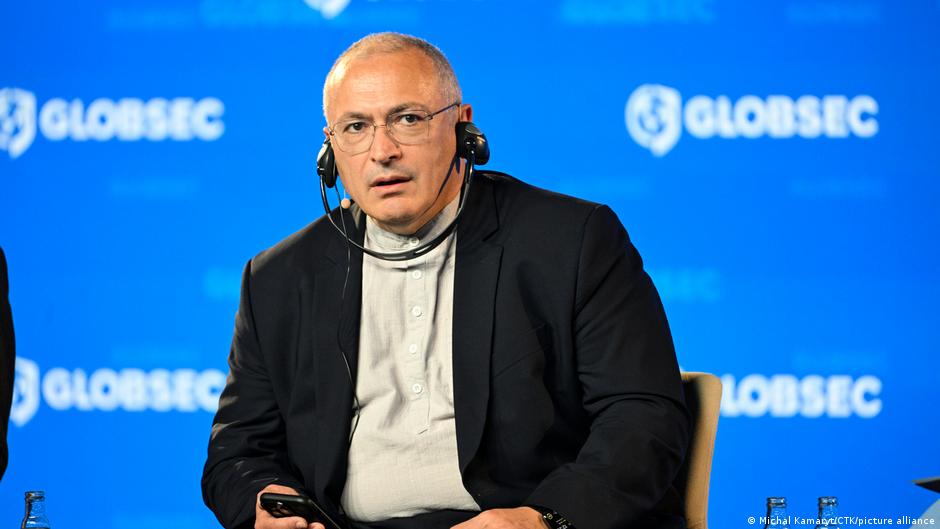
European governments should offer influential Russians a credible alternative to continued support for President Vladimir Putin, according to public figure Mikhail Khodorkovsky, who argues that changing the incentives facing the country’s political and business elite could help fracture the coalition surrounding the Kremlin.
Speaking on November 3 at a Russian Anti-War Committee conference in Brussels, Khodorkovsky said powerful figures remain aligned with Putin partly because they cannot be confident that a post-Putin system would leave them better off. His argument frames political loyalty as a strategic calculation: even individuals dissatisfied with the current order may continue supporting it when defection carries clear costs but offers no viable path to personal security.
Asked whether insiders could remove Putin, Khodorkovsky pointed to the extensive security system the Russian president has constructed around himself. That architecture makes an internal challenge difficult, while uncertainty about the consequences of political change further discourages potential defectors.
“If we are talking about a split among the elites, then we need to demonstrate opportunities for an individual exit,” Khodorkovsky said.
Such an exit could still entail losses for those involved, he added. However, he called Europe’s failure to create meaningful off-ramps by the fifth year of the war a serious strategic error.
Elite incentives and the limits of sanctions
Khodorkovsky did not specify the terms that European governments should offer at the Brussels conference. In earlier comments, however, he wrote that a declaration of disagreement would not be sufficient for people who had cooperated with the regime. He cited donations to Ukraine and testimony provided to investigators examining crimes committed by the authorities as examples of more substantive action.
For European policymakers, the proposal raises a central issue in sanctions strategy: whether pressure is designed only to impose costs or also to change behavior. Measures that leave targeted individuals with no route to rehabilitation may reinforce the Kremlin’s internal cohesion, even as they weaken the financial position and international mobility of Russia’s elite. Khodorkovsky’s approach would combine penalties with conditional opportunities for individuals willing to break with the system and provide tangible assistance.
The same incentive problem extends beyond senior officials and wealthy business figures. In his opening address, Khodorkovsky warned that a future political transition could become violent if it centered on broad prosecutions or restrictions against people connected to the war.
Millions of Russians have links to the conflict, he said. They or their relatives may have fought, worked for military enterprises or supported the order established by the government. Some are accustomed to handling weapons and could resist attempts to remove their rights or punish them collectively.
“And we must understand that when we talk about lustration, reparations and trials of war criminals, we are talking about a new war,” he said.
The warning does not eliminate the question of accountability. Instead, it highlights the management challenge facing any post-Putin administration: distinguishing individual responsibility from sweeping exclusion while preventing military, security and industrial constituencies from mobilizing against a new political order.
Transition risks for the state and economy
Khodorkovsky contrasted forced transformation with national reconciliation and gradual democratization. In his assessment, an armed confrontation inside Russia would produce another authoritarian government and postpone democratic change for another political generation.
He issued a similar warning about the possible disintegration of the Russian Federation, saying such an outcome would be paid for in blood. He urged policymakers to discuss not only their preferred end state but also the methods used to reach it.
For companies and investors, these scenarios carry consequences far beyond the transfer of political power. Violent fragmentation could disrupt corporate ownership, supply chains, energy exports and the command structure governing strategic industries. A negotiated transition, by contrast, would still involve significant uncertainty but could preserve administrative continuity while institutions are redesigned.
Khodorkovsky proposed focusing on what he called “institutional de-escalation”: reducing the threat of war by changing how power is organized in Russia. He argued that even a shift from one-person rule to collective leadership could lower the likelihood of conflict. A parliamentary model and greater federalization would reduce it further, in his view.
That prescription amounts to a governance strategy rather than a simple change of chief executive. Collective leadership would distribute decision-making authority, while parliamentarism and federalization could create additional checks on the concentration of political and economic power. The proposal also implies a more complex competitive landscape in which regional authorities, legislators, state corporations and private-sector interests would have greater influence over national policy.
The two-day Russian Anti-War Committee conference is taking place in Brussels on November 3-4 and is examining scenarios for ending Russia’s war against Ukraine. Its agenda also includes discussions of sanctions, nuclear risks and the possibility of putting Putin on trial.