Ukraine Says 28 Killed in Russian Barrage as War Costs Test Western Policy
The mass missile and drone attack underscored how sanctions, energy revenues and escalation risks remain central to the war’s strategic balance.
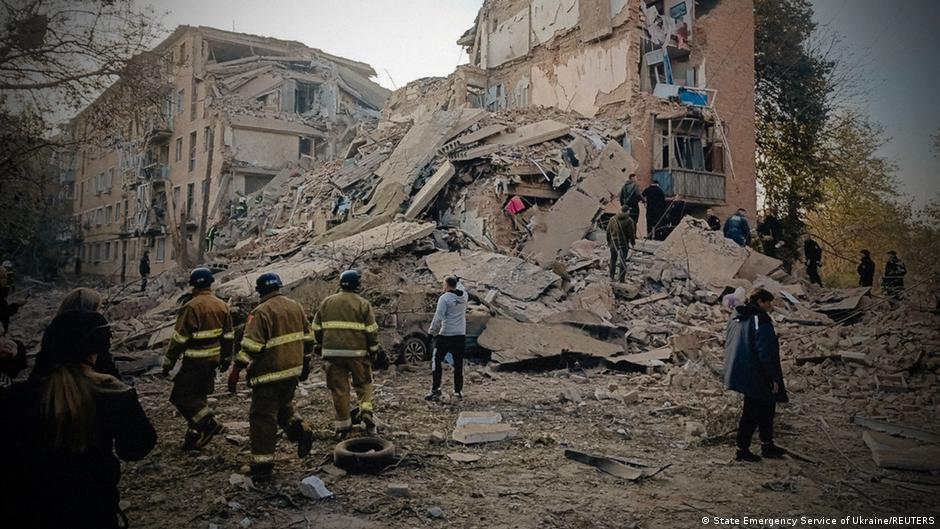
Ukraine said 28 people were killed after a large-scale Russian attack using missiles and drones, a strike that Ukrainian officials framed not only as a military escalation but as evidence that Moscow still sees the war as financially and politically sustainable.
Interior Minister Ivan Vyhovsky said in a Telegram post on Wednesday evening, October 7, that 28 people had died across Ukraine as a result of the mass shelling by Russian forces. He said emergency workers and police had pulled people from rubble, evacuated residents from destroyed buildings and rescued others from fires, saving 29 people in total.
The heaviest reported toll was in Pryluky, in the Chernihiv region, where Vyhovsky said 20 people were killed after a missile struck a residential apartment building. The dead included five children, three of them one year old, according to the minister. He said clearance operations at the site had continued for more than 14 hours.
President Volodymyr Zelensky said 100 people were wounded in the attacks. In his own Telegram post on Wednesday evening, he described the strike as a combined assault involving many ballistic missiles, many cruise missiles and Shahed drones. He said further attacks followed during the day with Shaheds and aerial bombs.
“Putin does not feel that this creates problems for him,” Zelensky said, arguing that the Russian leadership is being encouraged by signals that the pressure campaign against Moscow may be weakening.
Sanctions as a Strategic Balance Sheet
For business and policy leaders, Zelensky’s response placed the attack within a broader question of incentives. His argument was that Russia’s ability to keep selling oil, earn revenue in dollars and euros, and face what he characterized as weaker sanctions pressure affects the Kremlin’s calculation of the costs and benefits of continuing the war.
Zelensky said that the “weakening” of sanctions against Russia and “signals about lifting sanctions from oligarchs” amount to signals of normalization of the war against Ukraine. He argued that as long as President Vladimir Putin can still sell oil and count profits in hard currency, the war continues to pay off for Moscow and remains advantageous to pursue.
That framing makes the attack relevant beyond the immediate military and humanitarian consequences. It puts sanctions enforcement, commodity flows, political signaling and elite pressure at the center of Ukraine’s case to Western governments. In Zelensky’s account, Russia’s battlefield behavior is linked to the economic environment in which Russian decision-makers operate.
The Ukrainian president called the issue a problem not only for Ukraine and its people, but for everyone in Europe and the Western world. His comments suggested that Kyiv sees Western policy coherence as a core part of the competitive landscape of the war: if pressure on Moscow appears inconsistent, Russia may interpret that as room to escalate.
Operational Impact and Management Decisions
The October 7 assault also showed the strain placed on Ukraine’s emergency management systems. Vyhovsky said staff from the State Emergency Service and police were involved in rescue and evacuation operations, including extracting survivors from under debris and removing people from damaged buildings. Those details highlight the operational burden imposed by repeated attacks on civilian infrastructure and residential areas.
In Pryluky, the extended debris-clearance effort after the missile strike on a multi-storey residential building reflected both the severity of the damage and the resource intensity of recovery operations. Vyhovsky said the work had gone on for more than 14 hours. Zelensky also said that throughout the day, crews had continued clearing rubble after the Russian missile strike on the city.
Vyacheslav Chaus, head of the Chernihiv regional military administration, had earlier reported more than 50 injured as a result of the attack. That figure, together with the later national total of 100 wounded cited by Zelensky, points to the scale of simultaneous demands on regional authorities, hospitals, police and emergency workers.
Zelensky said Russian forces attacked 13 Ukrainian regions on October 7, using 70 missiles, a large number of ballistic weapons and Shahed drones. The breadth of the attack matters for Ukraine’s management of air defense, emergency response and public communications. A strike pattern across many regions forces authorities to allocate scarce response capacity across multiple locations at once.
Competitive Landscape of a Prolonged War
The attack came as Kyiv continues to press partners for sustained attention and support. Zelensky stressed the importance of leaders not staying silent about what happened and about what he said was Russia’s intention to keep moving toward escalation, killings and shelling. In business terms, Ukraine is seeking to shape the external environment in which Russia assesses risk, cost and strategic opportunity.
The competitive landscape is therefore not limited to weapons systems on the battlefield. It includes sanctions policy, energy revenue, the treatment of Russian oligarchs, political messaging and the willingness of European and Western leaders to maintain pressure. Zelensky’s comments indicate that Kyiv sees ambiguity in any of these areas as a signal that Moscow may read as permissive.
The Ukrainian position, as presented after the attack, is that Russia’s strategy is reinforced when the economic consequences of escalation remain manageable. That places Western governments in the role of market regulators and strategic counterparties: their choices on sanctions, enforcement and exemptions can change the perceived return on continued aggression.
For companies, investors and policymakers monitoring regional risk, the episode underscores how military escalation in Ukraine remains tied to wider economic and geopolitical decisions. Energy trade, sanctions compliance, cross-border exposure and political risk assessments all sit within the same strategic frame that Ukrainian officials are urging partners to consider.
The immediate facts remain stark: 28 people killed, 100 wounded, 13 regions attacked, 70 missiles used, and rescue operations continuing for hours in devastated residential areas. Kyiv’s broader message is that such attacks will not be deterred by condemnation alone if Moscow continues to believe that the financial and political costs of escalation are tolerable.